10 Best Mechatronics Courses for Automation, Robotics, and Technician Careers
Last updated on:
June 18, 2026
Key Takeaways
Mechatronics courses range from 35-hour self-paced intros to two-year community college certificates and graduate programs.
Not all online mechatronics courses include real hands-on practice. Check for a hardware kit, virtual lab, or campus access before enrolling.
A certificate of completion and a college credit certificate are not the same thing. Only credit certificates are transcripted, stackable, and employer-recognized.
PLC programming and robotics are the highest-demand skills in automation. Not every program covers both, so always read the actual curriculum.
Beginner mechatronics courses with no prerequisites exist. No engineering background is required to start.
Community college programs typically offer the strongest hands-on preparation and direct employer connections for technician roles.
Graduate mechatronics programs require an engineering degree and are not suitable for career changers or first-time learners.
Course costs range from around $700 for a short online option to more than $15,000 for an undergraduate certificate.
Unmudl offers beginner-ready mechatronics courses developed with Amazon's RME program, rated 4.84 out of 5 by more than 600 learners, with no prerequisites.
Explore the best mechatronics course options for automation, robotics, and technician careers, including Unmudl, eCornell, OSU, Bay College, CLC, and more, with comparisons by format, cost, credential, and learner fit.
Searching for a mechatronics course? There are dozens of options out there, and most comparison articles either list random MOOCs or quietly advertise one program.
This list is different. We compared 10 programs across short online courses, community college certificates, undergraduate certificates, and graduate programs to identify the ones that actually teach the skills employers want: PLC programming, robotics, electrical systems, mechanical systems, and real-world automation troubleshooting.
There is no single best mechatronics course for every learner. The right fit depends on your experience level, career goal, budget, format preference, and whether you need a 35-hour beginner course or a full academic credential. Browse the full range of mechatronics courses to compare options by level and career path beyond this list.
Here is what we found.
Get the Inside Scoop on Booming Technician Careers – Free Webinar!
Curious about pay, work hours, and what a day in the life of a technician looks like? Watch the Techs of Tomorrow webinar for free for expert insights!
Employers We Have Worked With
Get the Inside Scoop on Booming Technician Careers – Free Webinar!
Curious about pay, work hours, and what a day in the life of a technician looks like? Download the Techs of Tomorrow webinar for free for expert insights!
Employers We Have Worked With
Get the Inside Scoop on Booming Technician Careers – Free Webinar!
Curious about pay, work hours, and what a day in the life of a technician looks like? Download the Techs of Tomorrow webinar for free for expert insights!
Employers We Have Worked With
Get the Inside Scoop on Booming Technician Careers – Free Webinar!
Curious about pay, work hours, and what a day in the life of a technician looks like? Download the Techs of Tomorrow webinar for free for expert insights!
Get the Inside Scoop on Booming Technician Careers – Free Webinar!
Curious about pay, work hours, and what a day in the life of a technician looks like? Download the Techs of Tomorrow webinar for free for expert insights!
Employers We Have Worked With
Browse Courses on Unmudl Today!
Start with Mechatronics and Robotics Maintenance, designed for warehouse associates and equipment operators. Unmudl's platform connects you to Career Choice funding and training that employers actually want.
Get the Inside Scoop on Booming Technician Careers – Free Webinar!
Curious about pay, work hours, and what a day in the life of a technician looks like? Download the Techs of Tomorrow webinar for free for expert insights!
Employers We Have Worked With
Get the Inside Scoop on Booming Technician Careers – Free Webinar!
Curious about pay, work hours, and what a day in the life of a technician looks like? Download the Techs of Tomorrow webinar for free for expert insights!
Employers We Have Worked With
Get the Inside Scoop on Booming Technician Careers – Free Webinar!
Curious about pay, work hours, and what a day in the life of a technician looks like? Download the Techs of Tomorrow webinar for free for expert insights!
Employers We Have Worked With
What Is a Mechatronics Course?
A mechatronics course is training that combines electrical, mechanical, computer, and control systems into a single discipline. The goal is to teach you how integrated automated systems work, and more importantly, how to operate, maintain, program, and troubleshoot them on the job.
This is different from a standalone electrical, mechanical, or robotics and automation course. A mechatronics technician needs to understand the full picture: why a conveyor line stopped, whether the fault is in the PLC logic, the motor drive, a sensor signal, or a mechanical component. That cross-system thinking is what mechatronics training specifically develops.
What Do You Learn in a Mechatronics Course?
Strong programs cover most or all of these skill areas:
Electrical systems: Circuits, wiring, and power distribution. The foundation for diagnosing automated equipment.
Mechanical systems: Motors, gears, drives, and motion components. Needed to maintain production machinery.
PLC programming: Ladder logic and programmable controllers. PLCs control virtually every automated production line.
Robotics and automation: Programming and operating industrial robots. A direct match to manufacturing job demand.
Sensors and actuators: Detection, feedback, and control inputs. Core to understanding how automated systems respond.
Hydraulics and pneumatics: Fluid-powered motion systems. Common in packaging, heavy industry, and manufacturing.
Motor control and VFDs: Speed and direction control for electric motors. VFDs appear in most modern industrial equipment.
Industrial safety: Lock-out/tag-out and hazard identification. Required before working around live machinery.
Equipment maintenance: Preventive and predictive maintenance routines. Reduces downtime and extends machine life.
Troubleshooting: Diagnosing and fixing electrical and mechanical faults. The core daily task of most mechatronics technicians.
Basic programming: Microcontroller coding with Arduino and similar platforms. Increasingly required as embedded systems expand.
Schematics reading: Reading schematics and blueprints. You cannot fix what you cannot read.
Who Should Take a Mechatronics Course?
Beginners with no technical background exploring automation careers for the first time
Maintenance technicians wanting to upskill in PLCs, robotics, or industrial controls
Career changers from mechanical, electrical, warehouse, or manufacturing backgrounds
Robotics and automation technicians expanding into broader systems knowledge
Employers comparing structured workforce training options for their teams
Engineers seeking a graduate-level mechatronics specialization
Quick Comparison: Best Mechatronics Courses at a Glance
#
Course
Format
Duration
Cost
Credential
1 ⭐
Unmudl - Introduction to Mechatronics
Online, self-paced
~35 hrs
~$700
Completion certificate
2
eCornell - Mechatronics Certificate
Online
3 months
$3,750 + ~$600 kit
Cornell certificate
3
OSU Ecampus - Mechatronics for Manufacturing Engineering
Online
33 quarter credits
~$480/credit
Undergrad certificate
4
Bay College - Mechatronics Certificate
Hybrid / online / in-person
Varies
Check provider
Certificate (AAS-stackable)
5
CSUSB - Online Mechatronics
Online, self-paced
Weeks to months
~$2,155
Non-credit certificate
6
UM-Dearborn - Industrial Mechatronics Grad Certificate
Online + evening
12 credits
Check provider
Graduate certificate
7
EIT - Graduate Certificate in Mechatronics
Online
6 months
Check provider
AQF Level 8 grad cert
8
College of Lake County - Mechatronics Technology Certificate
In-person
1 year
~$5,425
Career certificate
9
Howard CC - Mechatronics Certificate
Flexible
33 credits
Check provider
Career certificate
10
Shoreline CC - Mechatronics Certificate
On-campus
45 credits
~$126/credit
Cert of Proficiency
Costs reflect published or estimated amounts at time of writing. Verify directly with each provider before enrolling.
Are you thinking of entering the lucrative mechatronics sector?
Get started in 5 weeks with a certificate course from the comfort of your home!
Clear prerequisites or beginner-friendly open entry
Hands-on or lab-based learning component
Credential value: completion certificate vs. college credit vs. graduate qualification
Career relevance for technician and automation roles
Cost transparency and value for investment
Independent review signals where publicly available
Breadth across mechanical, electrical, and control systems
What Makes a Mechatronics Course Worth Choosing?
A strong mechatronics course does more than list topic names. It connects systems together, trains you to understand how machines work as a whole, and teaches you what to do when they break. Before enrolling, check that a program:
Covers both electrical and mechanical systems (not just one)
Includes PLCs, controls, sensors, or robotics in the actual curriculum (not just the title)
Offers hands-on mechatronics training through real projects, labs, hardware kits, or applied exercises
Provides a clear, recognized credential
Has realistic prerequisites that match your current level
Is transparent about cost and time commitment
Best Online and Flexible Mechatronics Courses
Online mechatronics training works well for beginners, working adults, and anyone who cannot commit to full-time campus attendance. Most mechatronics courses for beginners in this section require no prior technical background. Before enrolling, check how much hands-on content is actually included. Online convenience and real skill-building do not always come together automatically.
1. Unmudl - Introduction to Mechatronics
Best for: Beginners and career changers entering industrial automation
Unmudl's Introduction to Mechatronics was developed with Amazon's Robotics Maintenance Engineer (RME) program, which grounds the curriculum directly in real industrial maintenance roles rather than abstract theory.
This self-paced mechatronics course runs approximately 35 hours across 59 modules. Topics include math fundamentals, industrial inspection, safety, quality, electrical systems, automation basics, mechanical systems, and fluid power. Fully online and self-paced, it typically takes 4 to 5 weeks at around 8 hours per week.
Learners have rated it 4.84 out of 5 across more than 600 reviews, citing its clarity and direct applicability.
Beginner-friendly with no prerequisites. Industry-aligned curriculum developed with Amazon RME. Rated 4.84 out of 5 across more than 600 learner reviews. Fully flexible, self-paced schedule.
Our take: The best short online mechatronics course for anyone starting from zero in automation.
Best for: Working professionals seeking an Ivy League engineering credential
Cornell's eCornell platform delivers a 100% online Mechatronics Certificate through the College of Engineering. This is one of the more rigorous options on this list: a 3-month instructor-led mechatronics course running 6 to 8 hours per week.
The curriculum covers circuit building and analysis, microcontroller programming (Arduino, STM32), sensors, actuators, motor control, PLC fundamentals, and a capstone project where you design and prototype a working mechatronic device. eCornell ships an electronics hardware kit (approximately $600 additional) directly to enrolled students so lab work is genuinely hands-on.
eCornell holds a Trustpilot rating of 4.6 out of 5 across 91 reviews, with learners noting well-structured modules and flexibility for full-time workers.
Format: Online, instructor-led
Duration: 3 months, 6-8 hrs/week
Cost: $3,750 + ~$600 hardware kit
Credential: Cornell University certificate (~96 PDH)
Prerequisites: Basic circuit knowledge and some programming experience recommended
Cornell engineering brand with recognized employer standing. A hardware kit is shipped to enrolled students, enabling real hands-on lab work from home. Structured timeline with instructor-designed modules.
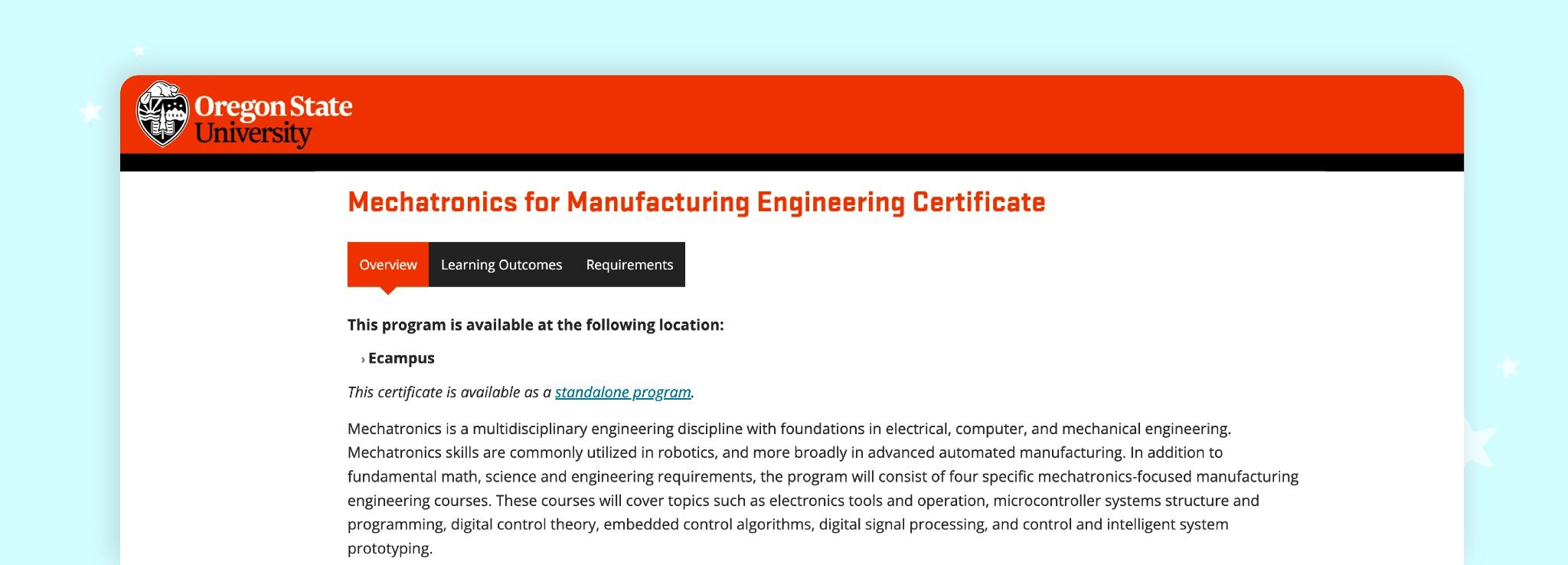
3. Oregon State University - Mechatronics for Manufacturing Engineering Certificate
Best for: Engineers and technical professionals seeking formal academic credit
OSU's Ecampus delivers a 33-quarter-credit online undergraduate certificate built from their ABET-accredited Manufacturing Engineering program. This is not a quick course. It is a structured academic pathway covering electronics tools and operation, sensors and actuators, microcontroller systems design and programming, digital control theory, DSP, and intelligent system prototyping.
At $480 per credit (flat rate for in-state and out-of-state students), total tuition runs approximately $15,840. That is a significant commitment, but the credential is transcript-posted and carries the weight of an academic minor in mechatronics from a nationally recognized engineering school.
Format: Online (OSU Ecampus, 11-week quarters)
Duration: 33 quarter credits, multiple terms
Cost: ~$480/credit (~$15,840 total tuition)
Credential: Official OSU undergraduate certificate (transcripted)
Prerequisites: Engineering background recommended; calculus and physics assumed
ABET-connected curriculum from a nationally recognized engineering school. Transcripted undergraduate certificate with full academic standing. Stackable toward further engineering study.
4. Bay College - Mechatronics Certificate
Best for: Learners who need genuine format flexibility
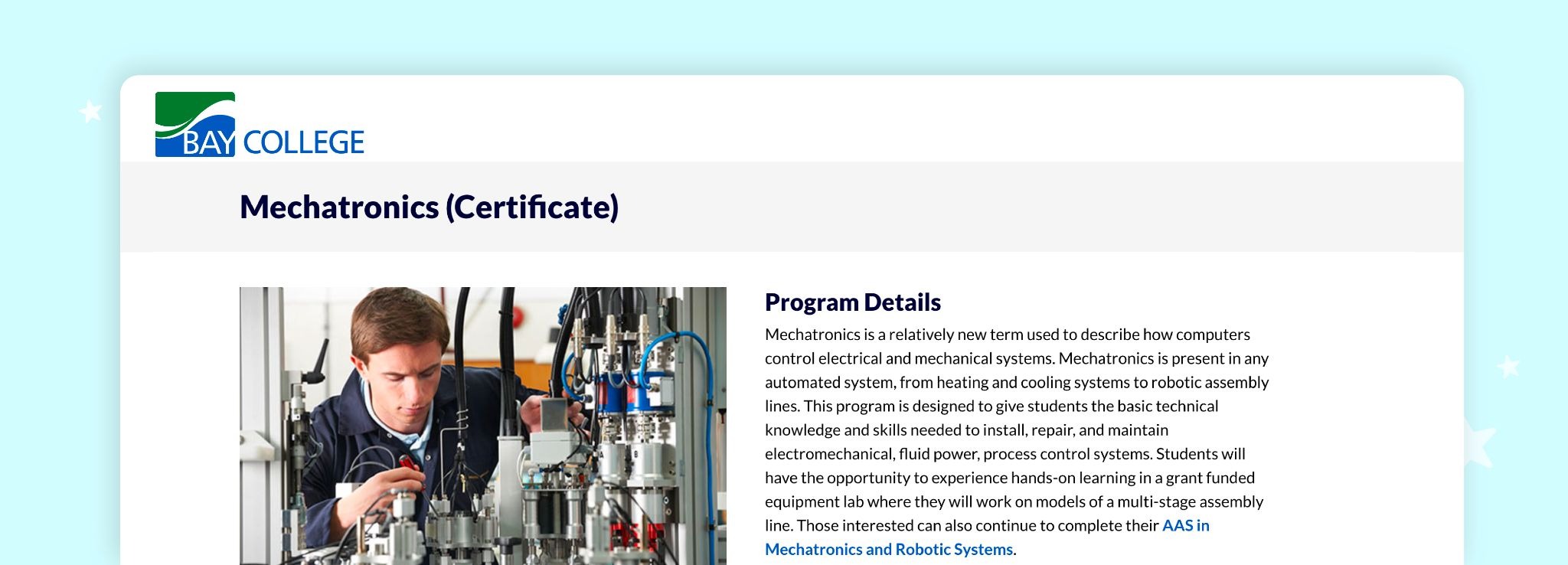
Bay College in Michigan stands out for offering something most programs do not: real delivery choice. You can access this as a traditional in-person program, a hybrid mechatronics program (online lectures plus campus labs), or fully online with optional at-home lab kits. The curriculum covers electrical fundamentals, fluid power, motor control, process control, PLCs, robotic systems, and CNC machining. Co-op and internship options are available.
Format: Traditional, hybrid, or fully online (student's choice)
Duration: Varies by pathway
Cost: In-district tuition (check provider)
Credential: Certificate (stackable toward Mechatronics and Robotic Systems AAS)
Prerequisites: High school diploma; math and reading placement
Three genuine delivery format options to suit different schedules. High-tech lab with a multi-stage assembly line model on campus. Co-op and internship opportunities are available. Credits are stackable toward an AAS degree.
Our take: The best flexible community college mechatronics certificate for working adults who need to balance study with employment.
5. California State University San Bernardino - Online Mechatronics
Best for: Beginners wanting a fast, affordable online overview
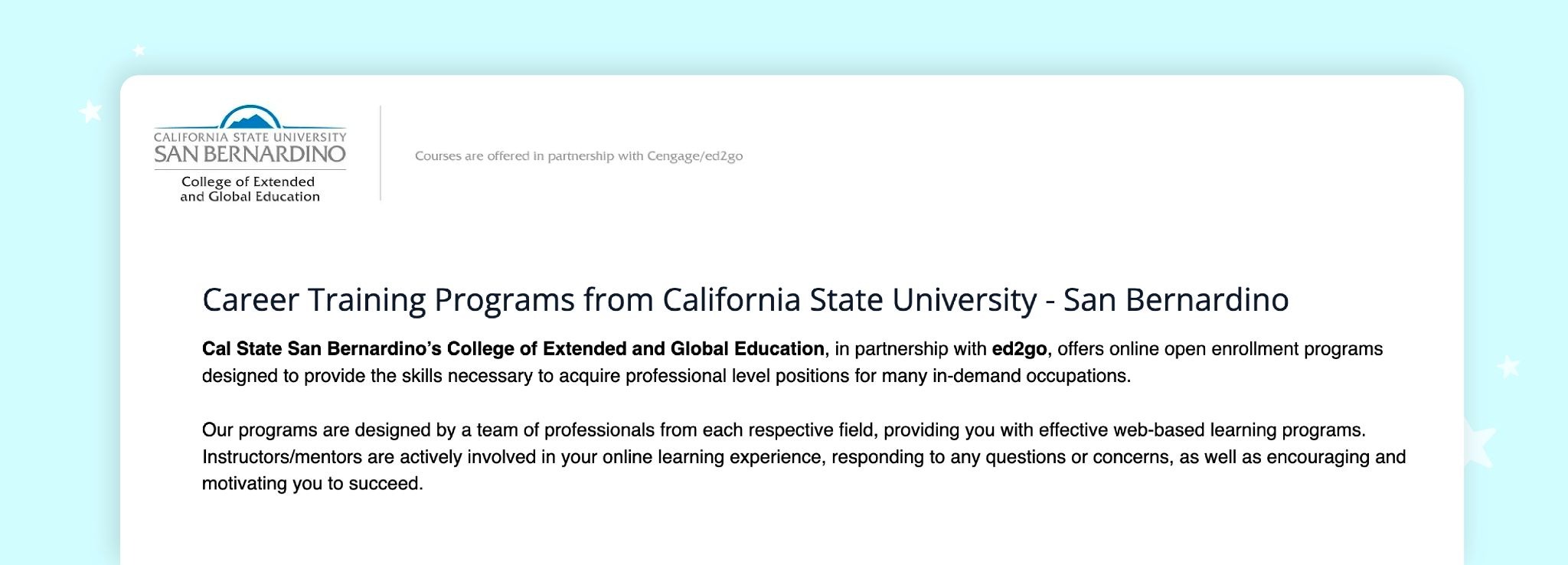
CSUSB's department offers a self-paced continuing education mechatronics course covering math, industrial inspection, safety, quality assurance, electrical and electronic systems, and mechanical systems. Virtual lab modules are included.
Format: Online, self-paced
Duration: Short (weeks to a few months)
Cost: ~$2,155
Credential: Certificate of completion (non-credit)
Prerequisites: None
Fully online with self-paced flexibility. Broad beginner topic coverage across core mechatronics subjects. No prerequisites required.
Best University and Graduate-Level Mechatronics Certificates
Graduate-level mechatronics programs are designed for engineers and advanced technical professionals who already hold a degree and want specialized credentials. These are not beginner programs.
6. University of Michigan-Dearborn - Industrial Mechatronics Graduate Certificate
Best for: Engineers in manufacturing or automotive sectors seeking graduate credentials
UM-Dearborn's 12-credit graduate certificate in Industrial Mechatronics covers industrial robotics, linear systems control, embedded systems, automotive mechatronics, motor drives, and industrial controls. Students choose four courses from a menu of seven, allowing some focus on robotics, embedded systems, or controls depending on their career direction.
Courses run online and in-person on evenings, which suits working engineers. The certificate is stackable into a related MS program at UM-Dearborn for those who want to continue further.
Format: Online + in-person evening courses
Duration: 12 credits (typically 1-2 years part-time)
University of Michigan brand recognition with strong employer standing. Evening and online scheduling designed for working engineers. Stackable toward a full MS engineering degree. Strong focus on automotive and industrial systems.
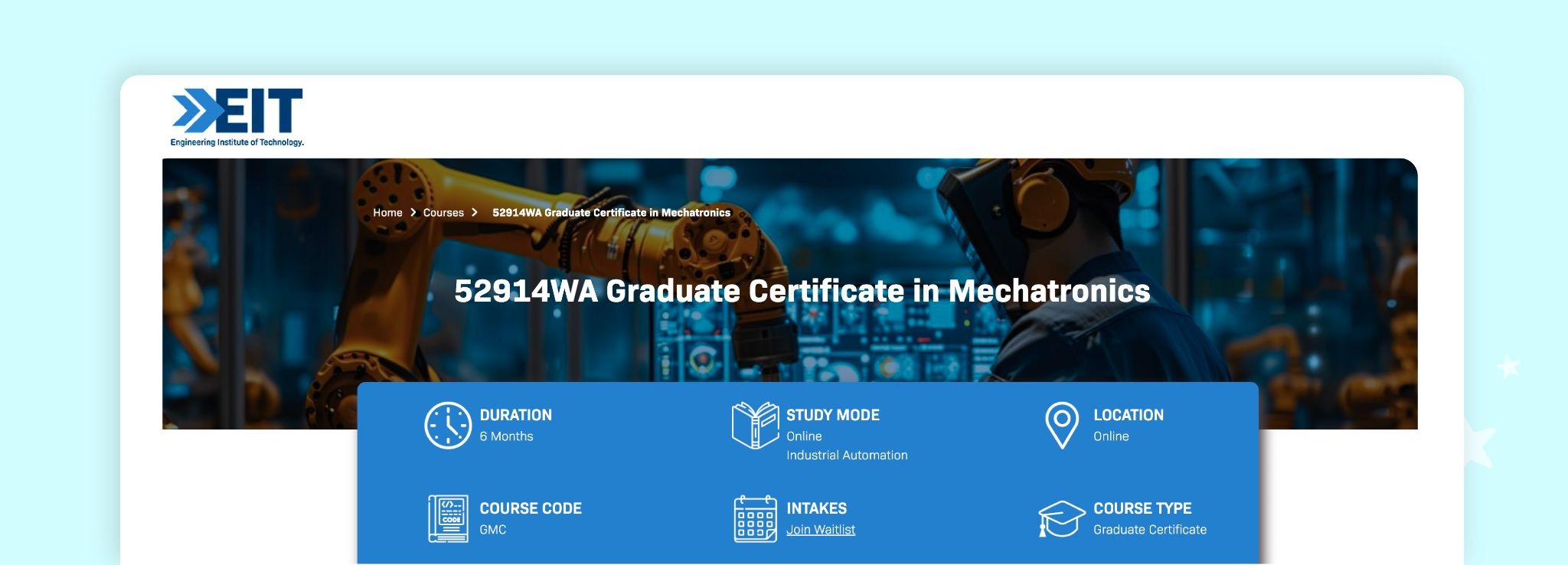
7. Engineering Institute of Technology - Graduate Certificate in Mechatronics
Best for: International engineering professionals seeking advanced specialization
EIT's six-month online Graduate Certificate in Mechatronics (52914WA) is an Australian AQF Level 8 qualification designed for working engineers. The curriculum is genuinely advanced: electronics for mechatronics, robot mechanisms and kinematics, embedded systems design, control theory and optimization, robotics design, and autonomous systems.
Delivery combines live weekly one-hour webinars with asynchronous materials, running approximately 10 to 15 hours per week. A global cohort and industry-engineer instructors give it a strong practical orientation.
Prerequisites: Engineering bachelor's degree or equivalent professional experience
Advanced, purpose-built curriculum for experienced engineers. Fast six-month completion timeline. Global cohort with industry-facing instruction.
Best Hands-On Community College Mechatronics Courses
In-person community college programs are often the strongest fit for learners who need real lab time, local employer connections, and structured industrial automation training to prepare for technician roles. These programs exist to place graduates into manufacturing jobs in their region.
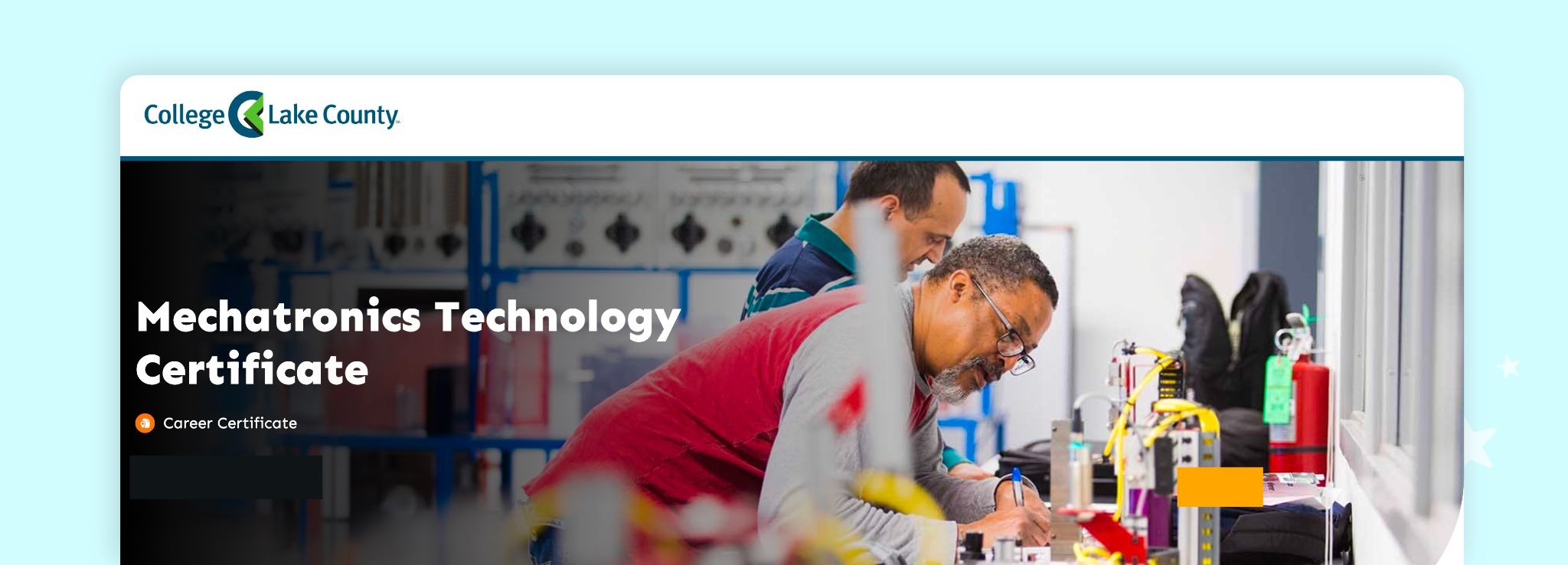
8. College of Lake County - Mechatronics Technology Certificate
Best for: Illinois learners who want hands-on industrial technician training
CLC's one-year Mechatronics Technology Certificate is a lab-intensive program covering industrial robot programming, PLC and VFD controls, automation troubleshooting, fluid power, and electrical and mechanical systems. Day classes are offered in Grayslake; evening classes at Lakeshore. WIOA funding, scholarships, and employer partnerships are available.
Students in this program regularly land automation and robotics technician roles before they complete the certificate.
Format: In-person (day or evening options)
Duration: 1 year
Cost: ~$5,425 in-district
Credential: Career certificate (stackable toward AR&M AAS)
Prerequisites: High school diploma or GED; college-level reading and writing placement
Hands-on labs with real industrial robots, PLCs, and VFD equipment. Day and evening scheduling options to suit working learners. WIOA funding and scholarship access available. Strong employer connections in the Lake County manufacturing sector.
9. Howard Community College - Mechatronics Certificate
Best for: Maryland learners and adult students wanting the broadest technician skill coverage
Howard CC's 33-credit Mechatronics Certificate stands out for curriculum breadth. Topics include CAD drafting, industrial safety, electronic circuits, mechanical systems, fluid power (pneumatics and hydraulics), robotics, advanced PLC programming, and VFD drives. Scheduling options include day, evening, weekend, and some online courses, which makes it realistic for working adults.
Format: Flexible (day, evening, weekend, some online)
Duration: 33 credits
Cost: In-district rates (check provider)
Credential: Career certificate (stackable toward AAS)
Prerequisites: College-level English and math placement
Widest skill coverage on this list, from CAD through advanced PLC and VFD programming. Flexible multi-schedule options to suit working adults. Credits are stackable toward an AAS degree. Strong DC/MD metro area job market for mechatronics roles.
10. Shoreline Community College - Mechatronics Certificate
Best for: Washington State students planning a longer college pathway
Shoreline's 45-credit Certificate of Proficiency is an on-campus program covering automation, electronics, machining, controls, industrial robotics, and mechanical systems. Open entry with no prerequisites makes it accessible from any starting background.
In-district tuition runs approximately $126 per credit plus a program fee of about $300 per quarter. Every credit also counts toward Shoreline's AAAS in Mechatronics for students who want to continue.
Format: On-campus (open entry, rolling start)
Duration: 45 credits
Cost: ~$126/credit + ~$300/quarter program fee
Credential: Certificate of Proficiency (transcripted)
Prerequisites: None (open entry; high school math recommended)
Open entry with no prerequisites. Affordable in-district tuition. All credits count toward the AAAS degree pathway. Broad technical foundation across automation, robotics, and controls.
How to Choose the Right Mechatronics Course
The right choice is rarely obvious from a course title. Here is a practical framework:
1. Start with your career goal. A technician or maintenance role points toward a community college certificate or a structured short course. Moving into engineering or controls design calls for a formal undergraduate or graduate certificate. Employers comparing workforce options benefit from flexible online programs with clear credentials.
2. Be honest about your current level. Graduate programs at UM-Dearborn and EIT require an engineering degree. OSU Ecampus assumes comfort with calculus and engineering fundamentals. Unmudl and CSUSB assume nothing.
3. Think carefully about format. Can you attend campus labs? Hands-on training matters more in mechatronics than in most other technical fields. If you are going fully online, check whether a hardware kit, virtual lab, or workplace practice is included in the program.
4. Match cost to credential value. A $700 completion certificate and a $15,840 undergraduate certificate serve very different goals. Research mechatronics course cost comparisons across program types before committing to a tuition payment.
5. Check for PLC and robotics coverage specifically. These are the highest-demand skills in industrial automation right now. Read the actual curriculum page, not just the course overview, before enrolling.
6. Verify the credential type. A non-credit completion certificate and a transcript-posted college certificate look very different to employers and to admissions offices if you plan to study further.
Mechatronics Certificate vs. Degree vs. Short Course
Short course (non-credit), 4-8 weeks: Best for beginners exploring the field. Builds a resume foundation but may not be recognized by all employers.
Certificate of completion, 4-8 weeks: Best for career changers building foundations. Useful for entry-level technician roles but carries no academic credit.
Community college credit certificate, 6 months to 2 years: Best for technicians and career changers. Strong regional employer recognition, stackable toward a degree, though lab attendance is usually required.
Undergraduate certificate, 1-2+ years: Best for engineers and professionals wanting formal academic credit. Good for advancement in manufacturing, though the cost and time commitment are significant.
Graduate certificate, 6-12 months: Best for degreed engineers. The strongest credential for senior and specialized roles, but an engineering degree is required to enroll.
Associate degree, 2 years: Best for learners building a long-term technician career. The broadest career flexibility of any option here, and the longest commitment.
The gap between a non-credit completion certificate and a credit-bearing online mechatronics certificate matters more than most learners expect before they start shopping programs. Transcripted college credit is stackable and transferable. A certificate of completion is neither.
What Jobs Can You Get After a Mechatronics Course?
Completing a mechatronics course does not guarantee a job. Outcomes depend on the depth of the program, your prior experience, how much hands-on practice you have built, your local employer market, and the type of credential you earned.
That said, following a clear mechatronics career path through targeted training opens doors to roles like:
Mechatronics technician: PLCs, electrical and mechanical systems, troubleshooting
Automation technician: Controls, sensors, programming, system integration
Robotics technician: Robot programming, maintenance, safety systems
Equipment maintenance technician: Diagnostics, fluid power, motor control
Controls technician: PLC/VFD programming, SCADA, logic systems
Electromechanical technician: Circuit testing, device assembly, system diagnostics
Field service technician: On-site installation, schematics, customer-site repair
Manufacturing technician: Equipment operation, quality, process improvement
Is a Mechatronics Course Enough to Get a Job?
A short course builds foundational understanding, but most technician roles require a certificate program, associate degree, hands-on experience, apprenticeship, or employer-sponsored training. The Bureau of Labor Statistics lists an associate degree or postsecondary certificate as the typical pathway into mechatronics technician roles. A completion certificate alone typically signals interest, not readiness.
Mechatronics Salary and Job Outlook
The BLS reports a 2024 median annual wage of $70,760 for electro-mechanical and mechatronics technologists and technicians, with 1% employment growth projected from 2024 to 2034 and approximately 1,300 job openings per year driven largely by replacement needs.
Comparing nearby fields before choosing? Here is a quick breakdown. For a deeper look at how the disciplines differ in practice, see mechatronics vs robotics.
Mechatronics: Integrates mechanical, electrical, control, and computing systems. Key skills: PLCs, sensors, robotics, maintenance, troubleshooting. Best for technicians who maintain and repair complex automated systems.
Robotics: Focuses on robot design, programming, integration, and operation. Key skills: robot programming, kinematics, vision systems, safety. Best for those building or operating robotic equipment.
Automation: Focuses on making processes run with minimal human input. Key skills: PLC programming, SCADA, controls, process design. Best for engineers and technicians designing production workflows.
Industrial maintenance: Focuses on keeping machines running reliably. Key skills: troubleshooting, preventive maintenance, electrical repair. Best for workers focused on uptime and machine repair.
PLC training: Focuses on programmable logic controller programming. Key skills: ladder logic, HMI programming, Allen-Bradley, Siemens. Best for technicians specializing in control logic and automation systems.
Final Recommendation: Which Mechatronics Course Should You Choose?
The honest answer: the best mechatronics course is the one that matches where you are now with where you need to go next. A beginner looking to break into automation does not need a $15,000 undergraduate certificate. An engineer targeting a senior controls role does not need a 35-hour intro course.
For more on mechatronics career paths, program comparisons, and training ROI, the Unmudl Blog covers these topics in depth.
Learn In Demand Skills Employers Are Hiring For
Explore our career-ready "Mechatronics and Robotics Maintenance" designed with employers to help you get hired faster. Train for industrial maintenance in ~10–12 weeks, earn a certificate and get ready to interview for technician roles.
A mechatronics course teaches the integrated skills needed to work with automated systems: electrical, mechanical, computer, and control engineering combined into a single practical discipline. It trains you to understand, maintain, and troubleshoot machines that combine multiple systems.
Which course is best for mechatronics?
It depends on your level, format preference, and career goal. Beginners benefit most from short online intro courses or community college credit certificates. Engineers targeting specialization should look at undergraduate or graduate certificates.
Can I learn mechatronics online?
Yes. Several programs on this list are fully online, including Unmudl, eCornell, and OSU Ecampus. Hands-on lab work, hardware kits, or workplace practice still make a significant difference in developing real technician readiness.


.svg)