Robotics technician training prepares you to install, troubleshoot, maintain, and repair robotic and automated systems
Many real jobs use adjacent titles: automation technician, mechatronics technician, controls technician, PLC technician, and industrial maintenance technician
The right training path depends on your target role and environment, not just the credential name
Hands-on experience through labs, apprenticeships, or co-ops is what separates job-ready from job-searching
Robots are now used in various industries, from manufacturing and healthcare to military and exploration. They help in the construction of machinery, provide services, and perform jobs such as sorting and disassembly.
Most people searching for robotics technician training start by picking a school.
That is actually the second step.
Here is what most articles miss: the job you want might not be called "robotics technician" at all. And the program that sounds most impressive could easily be preparing you for work you never planned to do.
This article covers what robotics technician training actually means in the real job market, which path fits your specific goal, and how to avoid the costly mistakes that trip up motivated people every year.
Browse Courses on Unmudl Today!
Start with Mechatronics and Robotics Maintenance, designed for warehouse associates and equipment operators. Unmudl's platform connects you to Career Choice funding and training that employers actually want.
Unmudl matches you to hands-on training and hiring employers close to home. Sign up to see what's near you.
Good jobs, in your area.
Unmudl matches you to hands-on training and hiring employers close to home. Sign up to see what's near you.
Good jobs, in your area.
Unmudl matches you to hands-on training and hiring employers close to home. Sign up to see what's near you.
Good jobs, in your area.
Unmudl matches you to hands-on training and hiring employers close to home. Sign up to see what's near you.
What Is Robotics Technician Training?
Robotics technician training teaches you how to install, test, troubleshoot, maintain, and repair robotic and automated systems.
It is technician-level work. Not engineering-level. That difference matters enormously when you are choosing a program.
A strong robotics technician training program covers robot controllers, PLCs, sensors, motors, electrical troubleshooting, mechanical systems, pneumatics, hydraulics, conveyors, machine safety, and preventive maintenance. The format can be a certificate, associate degree, apprenticeship, trade school program, employer-sponsored training, OEM course, or online course.
In practical terms: you are not designing robots from scratch. You are keeping the ones already installed running at full capacity.
If hands-on floor work is your goal, robotics technician training is the right lane. Engineering programs are a different career road entirely.
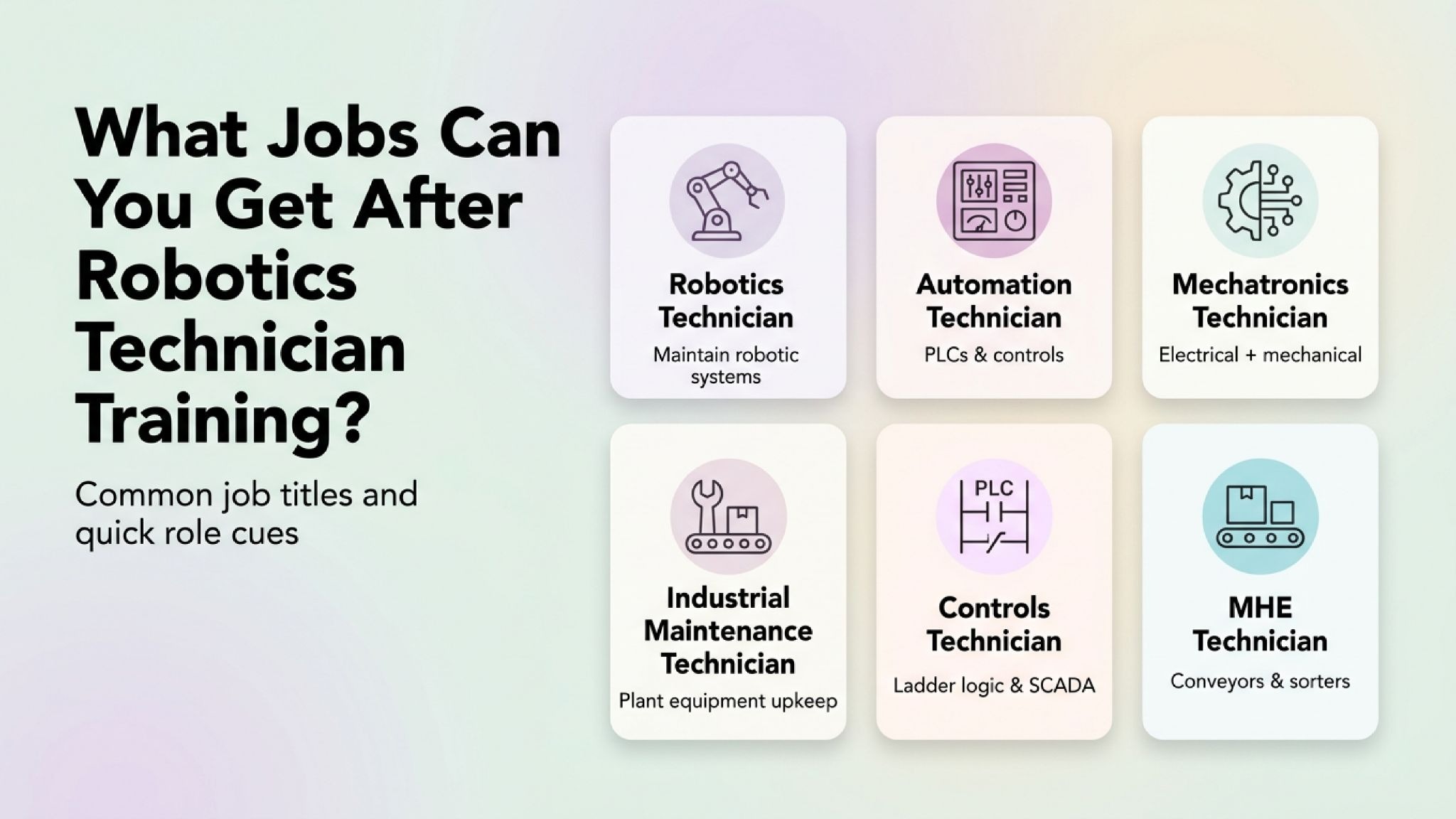
Why "Robotics Technician" Jobs Often Use Different Titles
According to O*NET, the sample job titles listed under the Robotics Technicians occupation include Automation Technician, Instrumentation and Controls Technician, Process Control Technician, and Programmable Logic Controllers Technician.
Most relevant jobs will not use the exact phrase "robotics technician" in the title.
That matters when you search for work. Look broadly for automation technician, mechatronics technician, controls technician, PLC technician, industrial maintenance technician, material handling equipment technician, and warehouse automation technician roles. They often describe the same daily work under a different employer label.
Warehouse automation and material handling equipment (conveyors, sorters, photo-eyes)
PLC and controls technician work (ladder logic, SCADA, instrumentation and controls)
Industrial maintenance (cross-disciplinary equipment maintenance and repair)
Mechatronics maintenance (electrical, mechanical, and robotics combined)
Robot programming and integration support (teach pendants, vision systems, motion programming)
Your target role determines which curriculum, which credential, and which kind of hands-on practice actually matters for you.
Step 2: Know what is required before you start.
Most robotics technician training programs require a high school diploma or equivalent, basic math skills, mechanical aptitude, computer literacy, and comfort with tools and safety procedures. Prior industrial, warehouse, or maintenance experience is helpful but not always required.
Step 3: Compare your training path options.
Certificates, associate degrees, apprenticeships, trade schools, online courses, employer-sponsored programs, and OEM robot training each serve different goals, timelines, and starting points. The next section breaks these down.
Step 4: Verify the curriculum teaches the right fundamentals.
Every credible robotics technician training program should clearly cover electrical fundamentals, AC/DC circuits, schematics, motor controls, PLCs, sensors, pneumatics, hydraulics, mechanical systems, robotics, conveyors, troubleshooting, and safety. Vague programs that gloss over fundamentals are a costly mistake.
Step 5: Understand exactly what "hands-on" means.
Programs use "hands-on" loosely. It can mean:
Physical lab access with real industrial equipment
Virtual lab or simulation software
PLC trainer kits only
Robot simulation only
Paid on-the-job training (OJT)
These are not equivalent. Physical troubleshooting experience is what employers actually test for in interviews and on the job.
Step 6: Build experience before applying.
Even entry-level robotics technician jobs frequently list experience requirements. Apprenticeships, internships, co-ops, maintenance helper roles, and warehouse automation support positions are the bridges that close that gap.
Step 7: Apply for all adjacent titles, not just one.
When you are ready, search for automation technician, mechatronics technician, controls technician, PLC technician, industrial maintenance technician, MHE technician, and robotics maintenance technician roles alongside "robotics technician."
Compare Robotics Technician Training Options
Online course: Best for working adults with some prior industrial background. Flexible and affordable, typically weeks to months. Needs practical reinforcement to be job-ready on its own.
Certificate program: Best for career changers seeking faster entry. Typically 3 to 12 months with medium hands-on intensity. Quality varies widely, so verify the curriculum carefully before enrolling.
Associate degree: Best for building a stronger technical foundation and clearing HR screening. Typically around two years. Broader coverage but a longer time commitment.
Trade school / community college: Best for hands-on learners who want local employer alignment. Typically 6 to 24 months with strong lab access and employer connections, though options vary by region.
Registered apprenticeship: Best for career changers who need paid training with a direct job pathway. Typically 1 to 4 years. Very high hands-on intensity through OJT, though availability varies by area.
Employer-sponsored training: Best for current employees and internal transfers. Free and aligned to the job, but tied to that employer's specific equipment and needs.
OEM robot training: Best for upskilling on brand-specific equipment after you already know the fundamentals. Days to weeks in duration. A poor choice as a first step.
What Skills Should a Robotics Technician Training Program Teach?
If a program cannot clearly show it covers these areas, look elsewhere:
Electrical fundamentals and schematics: AC/DC circuits and wiring diagrams are the foundation of every technician task
PLC programming and ladder logic: PLCs connect robots, conveyors, sensors, and full production systems
Motors, motor controls, sensors, and actuators: Servomotors, drives, encoders, and photo-eyes appear in nearly every automated environment
Pneumatics, hydraulics, and mechanical systems: Belts, bearings, conveyors, and fluid systems require both mechanical and hydraulic knowledge
Industrial robotics and robot controllers: Teach pendants, end-of-arm tooling, safety systems, and robot work cells
Troubleshooting and preventive maintenance: Fault diagnosis, PM routines, root cause analysis, and uptime support
Cobots, vision systems, and industrial networking: Human-robot safety, defect detection, barcode reading, and predictive maintenance basics
Looking for structured training built around this full skill stack? Mechatronics courses designed around these competency areas are a practical starting point.
Is Online Robotics Technician Training Enough?
Honest answer: it depends on where you are starting.
Online robotics technician training works well when you use it to build fundamentals, prepare for a certificate, or upskill with an existing industrial background.
It falls short when you have no prior hands-on exposure and plan to move directly into a technician job without any practical reinforcement.
Online training works well if:
You already have electrical, mechanical, or industrial work exposure
You pair it with a physical lab, apprenticeship, co-op, or employer project
You are preparing for a credential or certification exam
Your employer is covering the upskilling cost
Online training is not enough if:
You have never worked with industrial equipment
The program has no employer connections or credential pathway
You have no plan to build physical troubleshooting experience alongside it
Unmudl offers a Mechatronics and Robotics Maintenance course that is online, self-paced, and runs approximately 80 hours. It covers six content areas: fundamental skills, electrical systems, mechanical systems, fluid systems, industrial systems, and communication. The course aligns with four SACA microcredentials but does not itself confer those certifications.
It is designed for learners with some prior commercial or industrial exposure who want structured, flexible upskilling toward maintenance-oriented automation work. It is not the right fit for people starting from absolute zero. A free trial for mechatronics and robotics maintenance is available if you want to evaluate the course before committing.
How Long Does Robotics Technician Training Take?
There is no single answer. It depends entirely on the path you choose.
Short online course: 4 to 12 weeks. Best for upskilling when you already have some industrial background.
Certificate program: 3 to 12 months. Duration varies by credit hours and program format.
Trade school program: 6 to 18 months. Often includes labs and employer co-op options.
Associate degree: Around 2 years. The strongest technical foundation, with some programs offering accelerated options.
Registered apprenticeship: 1 to 4 years. Paid training that combines classroom instruction with extensive on-the-job mentorship.
OEM / employer-sponsored: Days to months. Varies widely by employer, equipment type, and role.
How to Get Robotics Technician Experience When You Have None
This is the part most guides skip entirely.
Even entry-level robotics technician roles frequently list experience requirements. Here is how to build that credibility before you have the job title:
Apply for registered apprenticeships. Amazon's DOL-validated Mechatronics and Robotics Apprenticeship includes 12 weeks of paid training, four industry-recognized certifications, and 2,000 hours of on-the-job mentorship, with no prior technical experience required.
Pursue internships and co-ops through trade school and community college programs with active employer partnerships.
Start in maintenance helper or equipment technician roles to build floor-level exposure from the inside.
Use warehouse or manufacturing operator jobs as internal stepping stones into automation support roles.
Build projects at home using inexpensive PLC trainer kits, wiring practice boards, and troubleshooting exercises.
Ask programs about employer partnerships before enrolling. If they cannot name employers they work with, that is worth noting.
Search every adjacent job title alongside "robotics technician" when applying.
Document all practical skills on your resume, including school lab work and personal builds.
Broad automation, mechatronics, and industrial maintenance training creates the widest opportunity. Narrow OEM-only or engineering-heavy training limits where you can go.
Common Mistakes to Avoid
Even highly motivated people make these errors:
Searching only for "robotics technician" and missing adjacent automation and maintenance openings
Picking a program that sounds advanced but skips electrical and mechanical fundamentals
Assuming online training alone can replace hands-on troubleshooting experience
Confusing robotics engineering with robotics technician work
Paying for a certification without verifying that target employers actually value it
Ignoring PLCs, electrical systems, and schematics when evaluating programs
Starting with OEM robot training before building general fundamentals
Not asking about labs, co-ops, internships, or apprenticeships before enrolling
Applying only to "robotics technician" titles instead of searching all adjacent roles
Choosing training that does not match local employer equipment and regional industry needs
FAQs About Robotics Technician Training
How do I become a robotics technician?
Choose a target role, complete a certificate, associate degree, apprenticeship, or employer-sponsored program that covers the fundamental skill stack, then build hands-on experience through labs, internships, co-ops, or maintenance-adjacent positions.
Do you need a degree to become a robotics technician?
Not always. According to O*NET, 23% of hiring managers for Robotics Technician roles listed a postsecondary certificate as sufficient for new hires. Apprenticeships and employer-sponsored programs are also valid pathways. The career training blog covers multiple entry routes in detail.
Is a robotics technician certificate worth it?
A certificate is worth it when it teaches job-relevant skills, includes real or simulated hands-on practice, and aligns with what target employers in your area actually require. It is a weaker investment when it is expensive, theory-only, and vague about job outcomes.
What is the difference between a robotics technician and an automation technician?
The roles overlap considerably. Robotics technicians focus more directly on robotic equipment and robot peripherals. Automation technicians often work across PLCs, conveyors, sensors, packaging lines, controls, and broader automated production systems.
Is robotics technician a good career?
It is a strong path for people who enjoy hands-on troubleshooting, automation, manufacturing, logistics, and maintenance work. The widest opportunities come from broader automation, mechatronics, controls, and industrial maintenance roles, not only positions with "robotics technician" in the title.
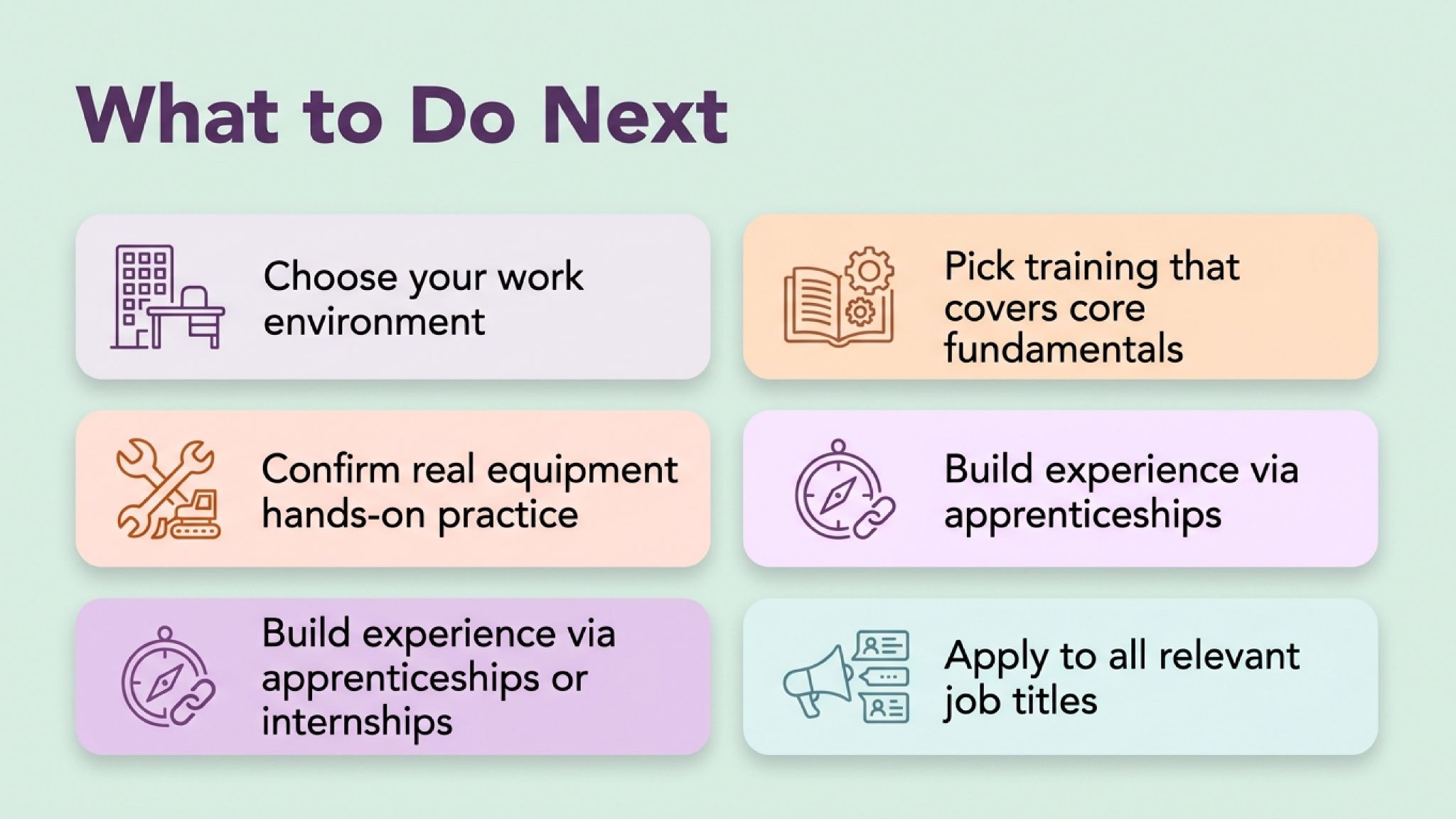
What to Do Next
The path forward is simpler than it looks once you know where you are starting from:
Decide which work environment you want: manufacturing, warehouse, controls, or integration support
Choose training that covers the full fundamental skill stack before anything brand-specific or advanced
Confirm the hands-on component involves real equipment practice, not simulation only
Use apprenticeships, internships, or maintenance-adjacent roles as your experience bridge
Search every relevant job title when applying, not only one
The robots are already installed. The technicians who keep them running are still in demand.
Learn In Demand Skills Employers Are Hiring For
Explore our career-ready "Mechatronics and Robotics Maintenance" designed with employers to help you get hired faster. Train for industrial maintenance in ~10–12 weeks, earn a certificate and get ready to interview for technician roles.
To become a robotic technician, you must have at least an associate degree in robot technology, with senior roles requiring additional degrees. Concentrate on your studies in science and math, with an emphasis on hydraulics, electronics, computer-assisted design and drawing, pneumatics, and microprocessors.
Is robotics a good career?
If you're looking for a lucrative and rewarding career, robotics is for you. Robotics experts are in high demand, with the average income in India being $4,53,236 per year.
What is the job of a robot technician?
A robotics technician is responsible for configuring, testing, running, maintaining, and troubleshooting robots and other automated systems used in manufacturing. Their primary goal is to improve the efficiency and lifespan of robotic equipment.
What do you need to become a robotics technician?To become a robotic technician, you must have at least an associate degree in robot technology, with senior roles requiring additional degrees. Concentrate on your studies in science and math, with an emphasis on hydraulics, electronics, computer-assisted design and drawing, pneumatics, and microprocessors. Is robotics a good career?If you're looking for a lucrative and rewarding career, robotics is for you. Robotics experts are in high demand, with the average income in India being $4,53,236 per year. What is the job of a robot technician? A robotics technician is responsible for configuring, testing, running, maintaining, and troubleshooting robots and other automated systems used in manufacturing. Their primary goal is to improve the efficiency and lifespan of robotic equipment.



_converted.webp)
.svg)









.png)
_converted.webp)