A clear guide to hard skills, including definitions, examples by industry, in-demand skills, resume tips, and how to build and prove measurable job-ready abilities.
Most people describe their hard skills the same way they describe the weather: vaguely, optimistically, and without any real proof.
"I'm proficient in Excel." "I have experience with data." "I'm tech-savvy."
Hiring managers have read these phrases so many times they have become almost invisible.
Hard skills are teachable, measurable abilities used to complete specific tasks in a job. They can be learned through education, training, certifications, apprenticeships, or work experience. And employers can verify them through tests, portfolios, licenses, projects, or on-the-job performance.
This article covers:
A clear hard skills definition and what sets them apart
The difference between hard skills vs soft skills, technical skills, and transferable skills
Hard skills examples by industry (office, data, marketing, trades, healthcare, and more)
The most in-demand hard skills in 2026
How to build, prove, and list hard skills on a resume
Let us start with the basics.
Get the Inside Scoop on Booming Technician Careers – Free Webinar!
Curious about pay, work hours, and what a day in the life of a technician looks like? Watch the Techs of Tomorrow webinar for free for expert insights!
Employers We Have Worked With
Get the Inside Scoop on Booming Technician Careers – Free Webinar!
Curious about pay, work hours, and what a day in the life of a technician looks like? Download the Techs of Tomorrow webinar for free for expert insights!
Employers We Have Worked With
Get the Inside Scoop on Booming Technician Careers – Free Webinar!
Curious about pay, work hours, and what a day in the life of a technician looks like? Download the Techs of Tomorrow webinar for free for expert insights!
Employers We Have Worked With
Get the Inside Scoop on Booming Technician Careers – Free Webinar!
Curious about pay, work hours, and what a day in the life of a technician looks like? Download the Techs of Tomorrow webinar for free for expert insights!
Get the Inside Scoop on Booming Technician Careers – Free Webinar!
Curious about pay, work hours, and what a day in the life of a technician looks like? Download the Techs of Tomorrow webinar for free for expert insights!
Employers We Have Worked With
Browse Courses on Unmudl Today!
Start with Mechatronics and Robotics Maintenance, designed for warehouse associates and equipment operators. Unmudl's platform connects you to Career Choice funding and training that employers actually want.
Get the Inside Scoop on Booming Technician Careers – Free Webinar!
Curious about pay, work hours, and what a day in the life of a technician looks like? Download the Techs of Tomorrow webinar for free for expert insights!
Employers We Have Worked With
Get the Inside Scoop on Booming Technician Careers – Free Webinar!
Curious about pay, work hours, and what a day in the life of a technician looks like? Download the Techs of Tomorrow webinar for free for expert insights!
Employers We Have Worked With
Get the Inside Scoop on Booming Technician Careers – Free Webinar!
Curious about pay, work hours, and what a day in the life of a technician looks like? Download the Techs of Tomorrow webinar for free for expert insights!
Employers We Have Worked With
What Are Hard Skills?
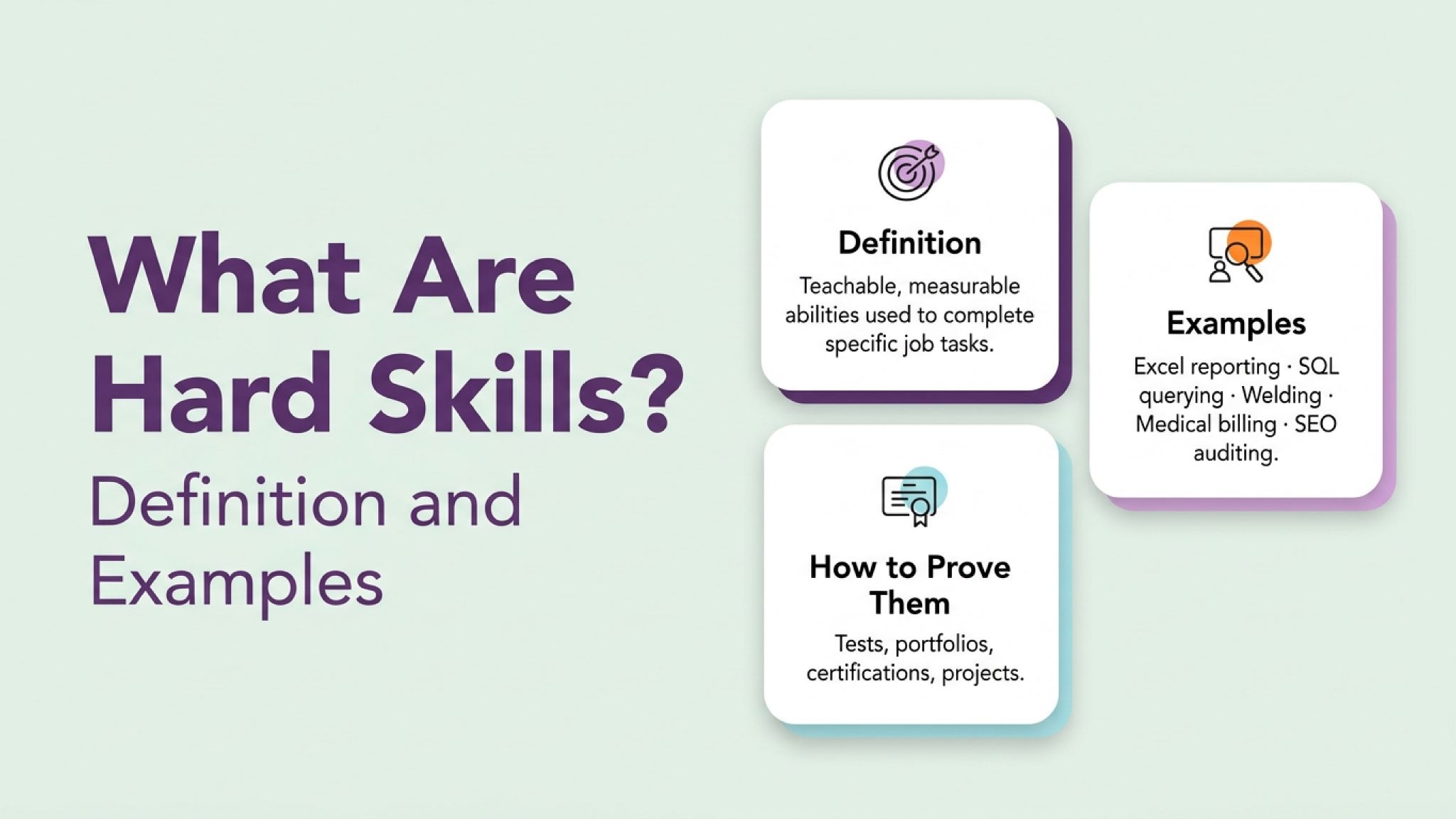
Hard skills are specific, teachable abilities tied to tasks, tools, technologies, processes, and measurable outputs.
The U.S. Department of Labor organizes occupations around knowledge, skills, abilities, tasks, and tools or technology. What most people call "hard skills" maps directly to this framework: the job-specific capabilities that connect a worker to the actual work.
Hard Skills Definition
A hard skill is an ability someone can learn, practice, measure, and apply to a specific job task.
Examples include Excel reporting, SQL querying, welding, bookkeeping, medical billing, CNC machine operation, and SEO auditing. The common thread: each one can be taught, tested, and improved with deliberate practice.
Hard Skills Meaning in the Workplace
Here is the distinction most articles miss.
Excel is a tool. Building a financial model or automating a monthly report is the hard skill.
Coding is syntax. Building, testing, and shipping working software is the hard skill.
CNC is a machine. Setup, measurement, safety, and production accuracy are the hard skills.
Employers are not paying for tool familiarity. They are paying for task completion, output quality, and problem-solving applied to real job situations.
Why Hard Skills Are Measurable Skills
Hard skills stand apart from soft skills because they can be observed, tested, and verified. Common verification methods include:
Technical assessments and skills tests
Work samples and project portfolios
Certifications, licenses, and apprenticeship records
GitHub repositories or code samples
On-the-job performance and output quality
That measurability is also why employers increasingly ask candidates to demonstrate hard skills rather than simply claim them.
Are Hard Skills the Same as Job-Specific Skills?
Many hard skills are job-specific. Welding, medical coding, CNC setup, and payroll processing belong to particular occupations.
But some hard skills travel across roles. Excel, data analysis, project planning, and CRM reporting are hard skills that move between finance, operations, marketing, and administration.
The value of any hard skill depends on how well it matches the role, the industry, and the task at hand.
We help people like you find new careers they love!
Contact us for a free consultation to begin your new career journey.
Why Are Hard Skills Important?
Here is an honest picture of today's job market.
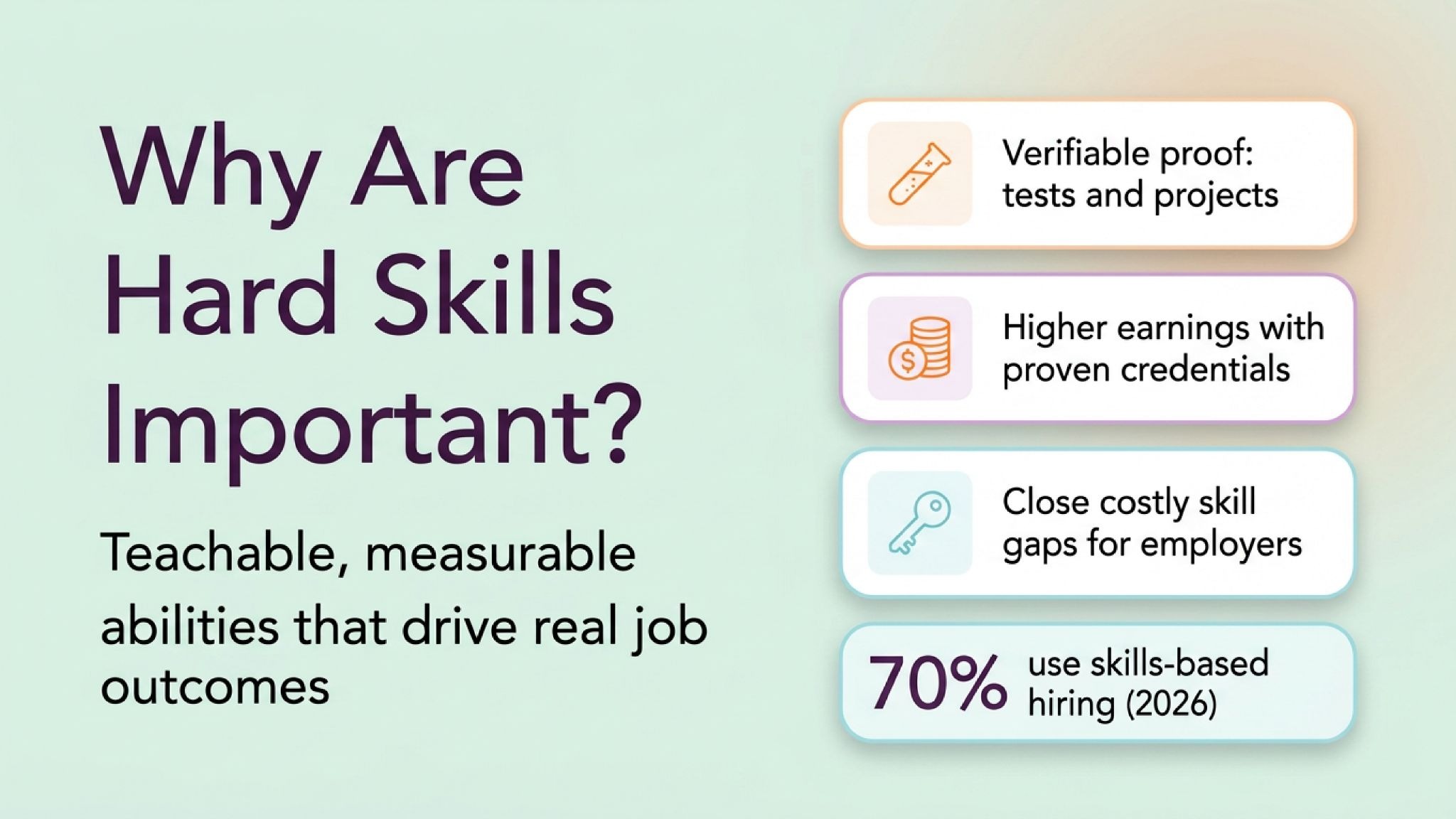
According to LinkedIn's Work Change Report, 70% of the skills used in most jobs will change by 2030. The pace at which professionals are actively adding new skills has already risen 140% since 2022.
The World Economic Forum's Future of Jobs Report 2025 adds that employers expect 39% of workers' core skills to change by 2030, with 63% of employers naming skill gaps as the primary barrier to business transformation.
At the same time, how employers screen candidates is shifting fast. NACE's Job Outlook 2026 reports that 70% of employers now use skills-based hiring, up from 65% the previous year. GPA screening dropped from 73% of employers in 2019 to just 42% in 2026.
The implication for job seekers: demonstrable hard skills matter more than ever.
On wages, BLS data shows that full-time workers with a certification or license had median weekly earnings of $1,460 in 2025, compared to $1,131 for those without one. That is a descriptive difference, not a causal guarantee. But verified, role-relevant hard skills are clearly associated with better labor-market outcomes.
Skill Gaps Cost Businesses Real Money
This is not just a candidate problem.
OECD research on skill gaps in firms finds that more than one in three firms report mismatches between needed and available skills. Among firms with gaps, technical skills top the shortage list at 46%. Those gaps increase workload for 63% of affected firms, raise costs for 50%, and limit technology adoption in roughly one in three cases.
The cost of a missing hard skill is an operating problem, not just a resume problem. Workforce teams looking to close those gaps can partner with Unmudl to connect employees with skills-aligned training built around real job requirements.
Hard Skills vs Soft Skills vs Technical Skills vs Transferable Skills
These four terms get confused constantly. Here is how they actually differ.
Hard skills are teachable, measurable capabilities tied to tasks or outputs, like SQL querying, bookkeeping, and welding. Employers verify them through tests, portfolios, licenses, and work samples. The most common mistake is treating them as only digital or technical.
Soft skills are interpersonal and behavioral capabilities that shape how work gets done, like communication, adaptability, and leadership. Employers look for them in interviews, references, and performance reviews. The mistake is dismissing them as unmeasurable or secondary.
Technical skills are a subset of hard skills, usually digital or engineering-based, like Python, CAD, cloud architecture, or PLC programming. Employers test these through coding challenges, systems design, and live assessments. The mistake is treating "technical" and "hard skills" as perfect synonyms.
Transferable skills are abilities usable across multiple roles and industries, like Excel, project planning, and data analysis. Employers verify them through demonstrations, portfolios, and role history. The mistake is assuming they are always soft skills, when many are measurable hard skills.
Credentials are proof signals that support a skill claim: certificates, licenses, and degrees. Employers verify them through document checks and exam records. The mistake is confusing a credential with demonstrated ability. A certificate says you learned something. A work sample proves you can apply it.
Hard skills show what you can do. Soft skills affect how you do it with others. Technical skills are a digital or engineering subset of hard skills. Transferable skills travel across roles. And credentials support the claim without replacing the actual ability.
Hard skills only matter in context. A skill that is essential in one role may be irrelevant in another. Here is what they look like across industries.
Business and Office: Bookkeeping, CRM administration, payroll processing, and advanced spreadsheet work are the core hard skills here. Prove them with a reconciled account sample, a CRM report, or a certification.
Data and Analytics: SQL, data cleaning, dashboard building, and statistical analysis are the foundation. Prove them with a query file, a live dashboard, a GitHub repo, or a documented analysis project.
Marketing: SEO auditing, Google Analytics 4, paid media reporting, and email automation are measurable marketing hard skills. A before/after ranking report or a campaign performance case study is strong proof.
Software and IT: Git version control, API integration, cloud deployment, and cybersecurity fundamentals sit in this category. Employers frequently test these directly. A repository history, a deployed project, or a completed lab assessment works well as proof.
Manufacturing and Skilled Trades: CNC setup, blueprint reading, welding processes, PLC programming, and preventive maintenance are the hands-on hard skills here. Proof comes from completed parts, setup sheets, maintenance logs, or apprenticeship records. Manufacturing & Trades courses are built around real employer skill needs in these sectors.
Healthcare and Admin: Medical coding, EHR system proficiency, billing, phlebotomy, and compliance documentation are regulated hard skills with real licensing requirements. Certifications, error-rate records, and documented clinical hours serve as proof.
Customer Service and Operations: Ticketing systems, POS platforms, inventory tools, CRM updates, and order processing are the hard skills that keep operations running. Case resolution metrics and system reporting samples prove them clearly.
For software and IT roles, employers frequently test these skills through live coding environments and systems design problems. Software & IT courses can help you build job-ready technical skills and produce proof artifacts in the process.
What Are the Most In-Demand Hard Skills in 2026?
Not all hard skills carry equal weight right now.
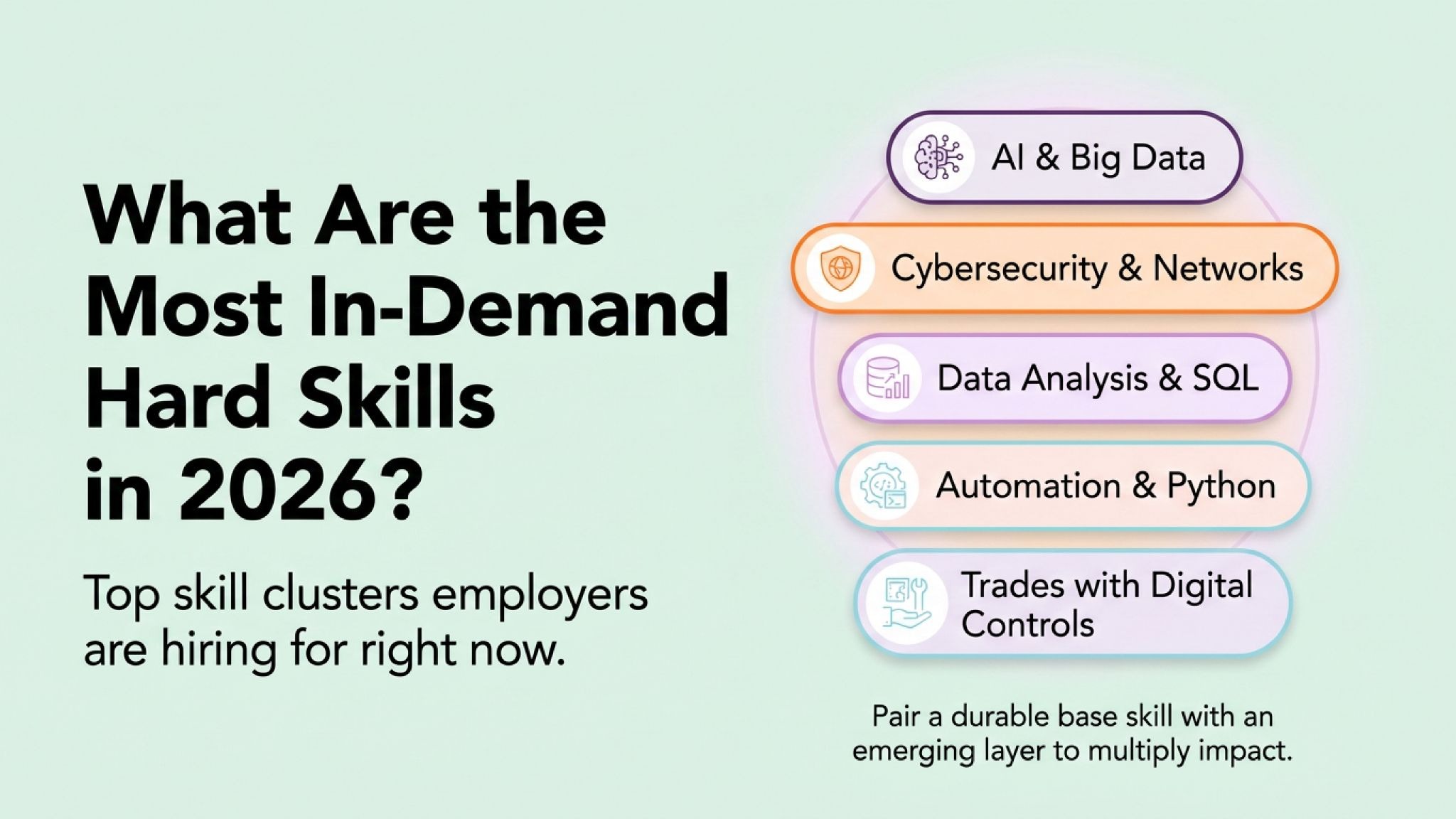
McKinsey Global Institute reports that demand for AI fluency in U.S. job postings jumped nearly sevenfold from 2023 to mid-2025, and is now a requirement in occupations employing roughly 7 million workers. The WEF Future of Jobs Report 2025 identifies the fastest-growing skill categories as AI and big data, networks and cybersecurity, and technological literacy.
But here is what the headlines miss: in-demand hard skills are not only in tech.
Skilled trades combine hands-on ability with digital controls. Healthcare hard skills tied to compliance, documentation, and regulated licensing remain in consistently high demand. Data analysis skills appear across marketing, operations, finance, and logistics.
The smartest approach right now follows a base + emerging stack model. Pair a durable skill you already know with an emerging layer that multiplies its value:
Excel + data analysis: business intelligence without a data science degree
SQL + dashboard building: self-serve reporting any team can act on
Python + automation: eliminate repetitive tasks at scale across any industry
Trade foundation + digital controls or PLC: advanced manufacturing capability
Marketing analytics + AI-assisted workflow: faster campaign testing and optimization
Project management + AI fluency: faster delivery with less overhead
If you are building from scratch, Data Analytics Level I using Excel is a practical entry point that builds a durable base skill and produces a proof artifact in a single course.
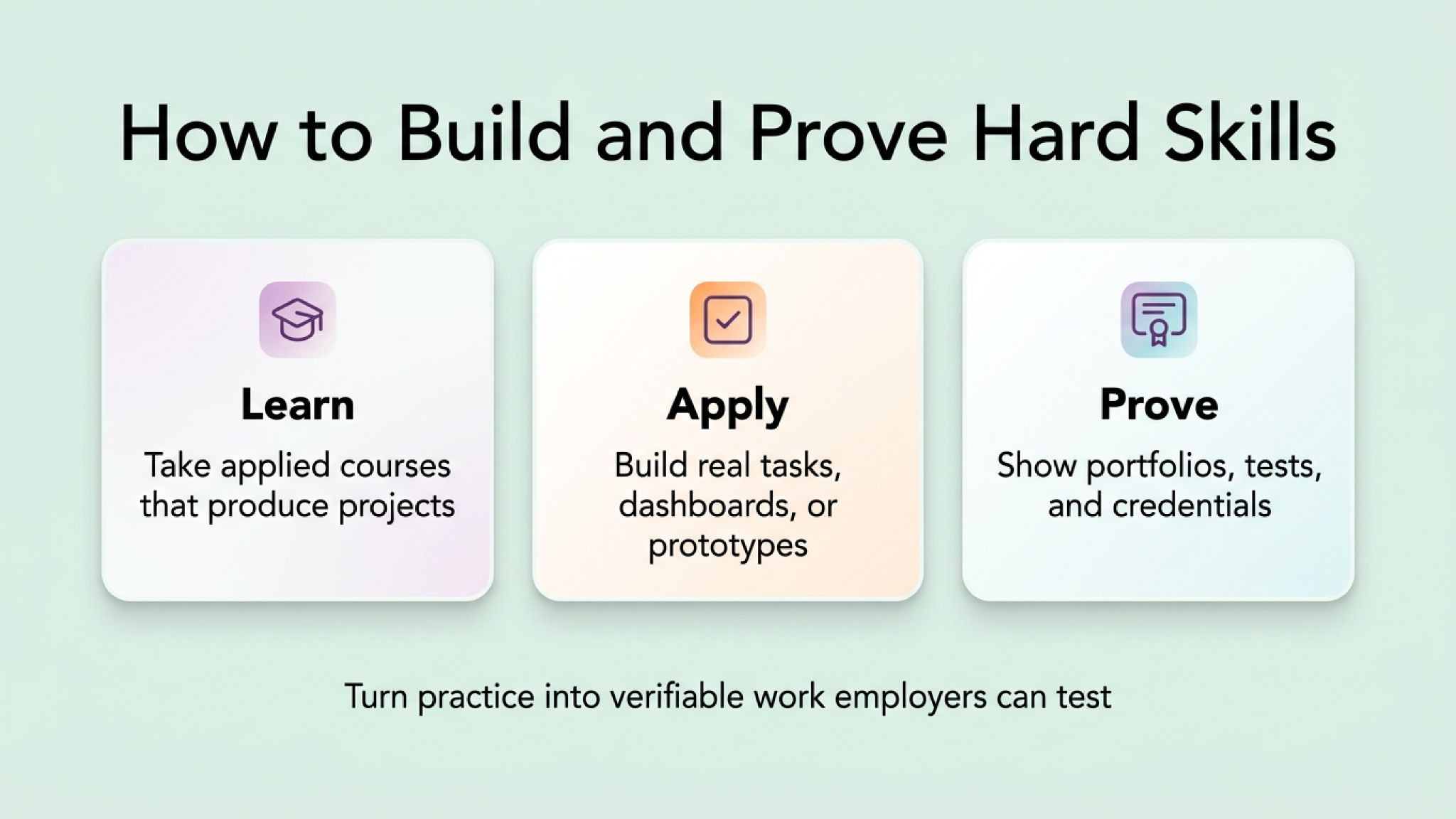
How to Build and Prove Hard Skills
Here is where most people stall. They learn. But they do not prove.
Hard skills improve through doing, not just studying. The fastest path: learn the concept, apply it to a real task, and produce something you can show.
Use Courses That Produce Proof
The best training connects learning to real job tasks and outputs. Choose courses matched to your skill level that emphasize applied work, not just passive video content.
Then pair every course with a project:
Build an Excel dashboard from a real dataset
Write SQL queries on sample data and document your findings
Complete a CNC or CAD simulation and export the result
Build a GitHub repository with documentation
Create a marketing analytics report with before/after metrics
The project is the proof.
Apprenticeships for Hands-On Hard Skills
For trades, manufacturing, technical support, and healthcare roles, apprenticeships combine paid learning with supervised practice and real credentials.
Apprenticeship.gov reports that registered apprenticeship completers earn an average starting salary of $86,000, with 93% employment retention after program completion. The community and technical college network includes pathways into these programs aligned with employer demand across multiple industries.
Credentials Support Proof, They Do Not Replace It
A certificate can help you get screened in. But it rarely closes the deal on its own.
Coursera's 2025 Micro-Credentials Impact Report shows that 96% of employers say microcredentials strengthen a candidate's application, and 90% are willing to offer higher starting salaries to holders. That is strong evidence for earning credentials.
But notice the language: strengthen. The credential supports the case. The applied skill makes it.
Weak: Marketing tools Strong: Google Analytics 4, SEO audits, paid search reporting, email automation
Research analyzing 8.75 million LinkedIn profiles found that workers who list specific, task-oriented skills are more likely to hold highly paid jobs, with skill-profile specificity explaining more earnings variation than education and experience signals alone.
Three rules for listing hard skills on a resume:
1. Match the job description. Scan for repeated tool names, required certifications, and technical methods. Mirror that language precisely.
2. Connect skills to outcomes. "Used SQL" is weak. "Used SQL to identify customer churn patterns that informed a support workflow reducing escalations by 20%" is strong.
3. Only list what you can prove. Assume any skill on your resume could be tested in a live technical screen or practical assignment.
🚫 Treating hard skills as only technical skills. Bookkeeping, medical coding, blueprint reading, and welding are all hard skills. Digital does not equal hard, and hard does not equal digital.
🚫 Listing too many generic examples. "Computer skills" tells employers nothing useful. "Pivot tables, VLOOKUP, financial modeling in Excel" is specific enough to actually matter. Strong Microsoft Excel skills listed precisely will always outperform vague category labels.
🚫 Confusing credentials with ability. A certificate opens a door. What you can do once inside is the actual hard skill.
🚫 Ignoring how employers verify skills. Companies like Amazon and Microsoft evaluate candidates through live coding environments, SQL challenges, and systems design problems. Build skills you can demonstrate under pressure, not just name on a page.
🚫 Ignoring skill obsolescence. Platform-specific and AI-exposed skills shift quickly. The solution is not to chase every new tool but to build durable base skills and layer emerging capabilities on top.
🚫 Skipping soft skills entirely. LinkedIn Learning research shows that professionals with strong soft skills are promoted 8% faster than those with technical skills alone. Hard skills open doors. Soft skills determine how far you walk through them.
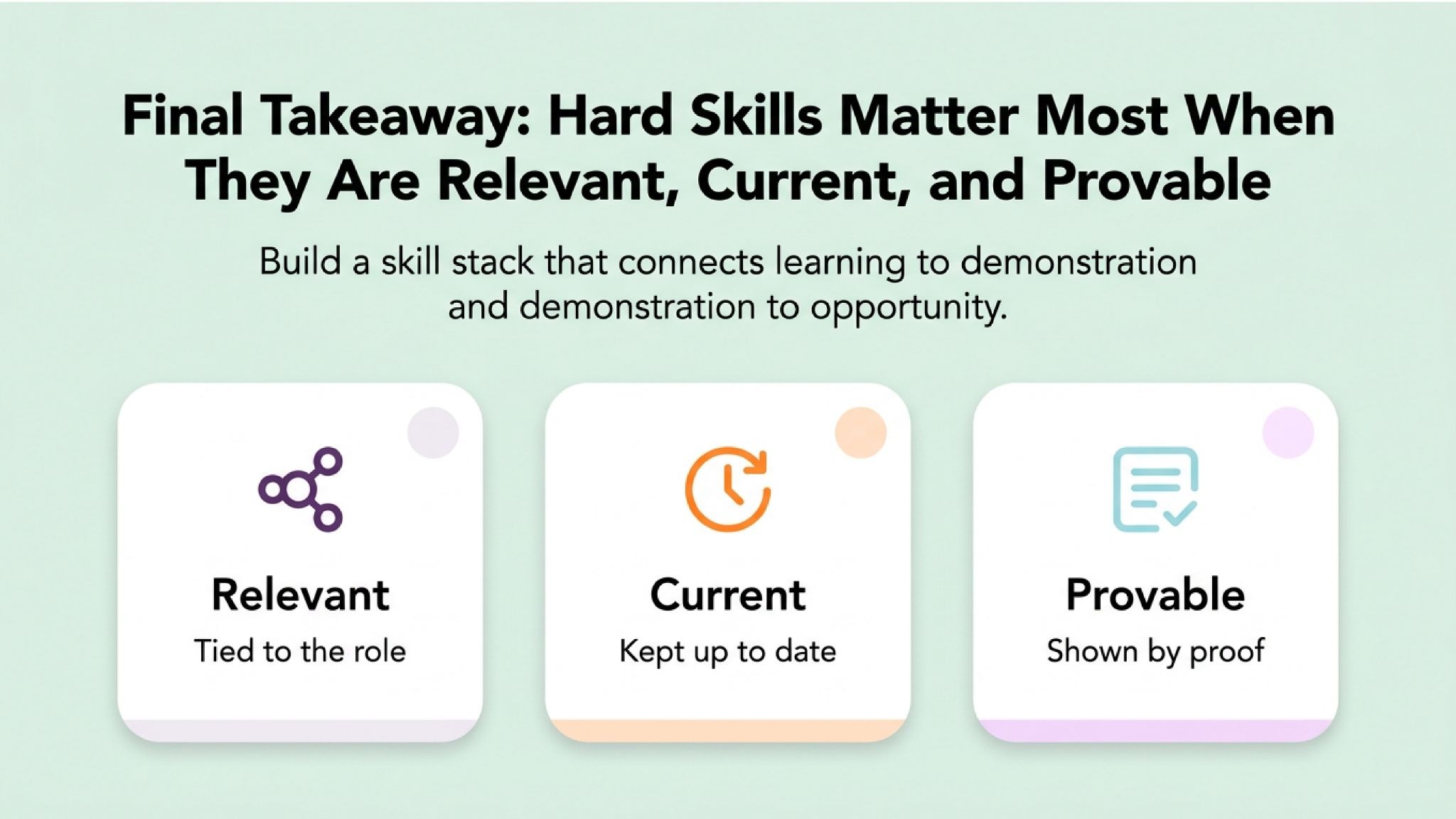
Final Takeaway: Hard Skills Matter Most When They Are Relevant, Current, and Provable
Here is the principle worth carrying with you.
Hard skills are not a static checklist. They are high-value but perishable. The ones that matter most are tied to a real role, verified by actual proof, and kept current as your industry evolves.
The best move is not to collect skills. It is to build a skill stack that connects learning to demonstration, and demonstration to opportunity.
Start with one skill cluster. Build something you can show. Add the next layer. Then signal what you know, specifically and clearly, on every resume and profile you send.
That is how hard skills turn into real outcomes.
Learn In Demand Skills Employers Are Hiring For
Explore our career-ready "Mechatronics and Robotics Maintenance" designed with employers to help you get hired faster. Train for industrial maintenance in ~10–12 weeks, earn a certificate and get ready to interview for technician roles.
A degree or other academic qualification, an industry-specific certification, coding skills, foreign language skills, typing speed, SEO marketing, bookkeeping, and computer skills are some examples of hard skills.
What is a hard vs soft skill?
Soft skills are those that come naturally and uniquely to each individual. Leadership, effective communication, teamwork, time management, motivation, and adaptability are examples of soft skills. Hard skills, on the other hand, are those acquired through hands-on experience, training, or education.
Is education a hard skill?
Yes, hard skills are technical knowledge or training gained through any life experience, including work or school.




.svg)


















_converted.webp)
_converted.webp)
